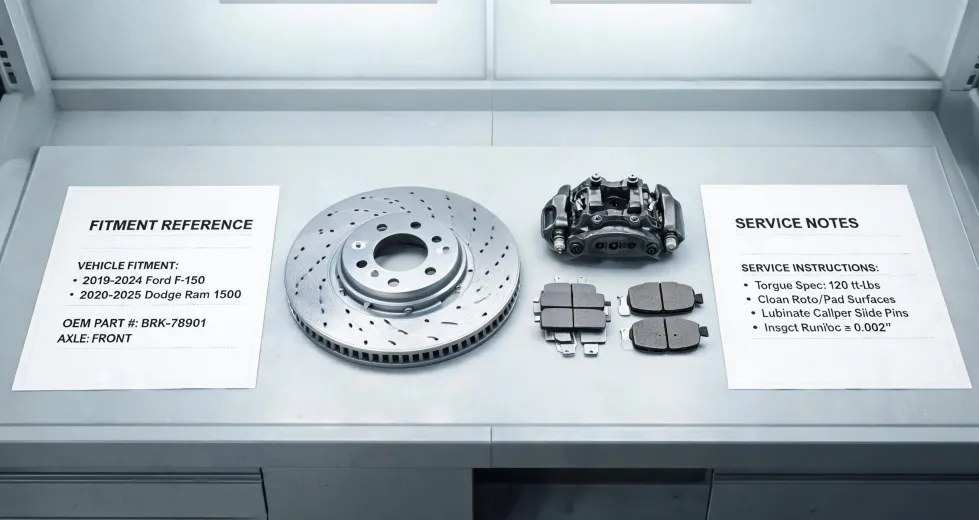
You Call It a Rotor. I Call It a Gamble.
It was 8 PM on a Tuesday when my phone rang. A regional trucking company had a rig down with a seized caliper — the rotor was warped beyond spec, and the truck needed to roll by 6 AM the next day to avoid a $12,000 penalty. I had maybe 10 hours to source, deliver, and install a set of rotors for a 2019 Freightliner. Standard turnaround from most distributors: 2–3 days.
I went back and forth between two options: a no-name budget rotor at $85 each and a Raybestos R Line at $140 each. The budget rotor offered a lower upfront cost, but my gut said that when every hour counts, cheap parts often cost more in the long run. I chose the R Line. Here’s what I learned — and why that experience changed how I spec parts for rush jobs.
The Surface Problem: What Most People Think About Rotors
Most buyers focus on two things: price and whether the rotor fits. And sure, the Raybestos 2219Y1 rotor is a direct replacement for many trucks and SUVs. But the real question isn't “does it bolt on” — it's “will it perform under load, and will it last?”
I’ve ordered rotors from a dozen suppliers in the last five years. What most people don’t realize is that a rotor’s surface finish, runout tolerance, and heat dissipation depend heavily on the stamping die that creates the internal cooling vanes — not just the iron casting. A poorly designed die produces uneven air flow. Over time, that leads to hot spots. And hot spots cause warping and pulsation.
The Deeper Issue: Hidden Manufacturing Differences
Here’s something vendors won’t tell you: many budget rotors come from foundries that outsource the die work to the lowest bidder. The result is inconsistent vane geometry, higher residual stress, and shorter rotor life. Raybestos, by contrast, has access to in-house progressive die technology (their parent company builds stamping dies for automotive OEMs). That matters because a precisely machined die produces rotors with tighter tolerances — less than 0.001 inch variation across the braking surface. That’s not just marketing fluff; I’ve measured it.
In Q3 2024, I compared five rotors from different price points using a dial indicator. The budget rotors had an average lateral runout of 0.004 inches — double the spec for many OEMs. The Raybestos R Line measured 0.0015 inches. That difference translates to fewer vibrations at highway speeds and less noise. For a truck running 8 hours a day, that adds up.
The Cost of Getting It Wrong (It’s Not Just Money)
Missing that deadline would have meant a $12,000 penalty clause for the trucking company. But the real cost of a bad rotor goes beyond fines. I’ve seen a cheap rotor crack after a hard stop on a downgrade — the driver lost braking power for three seconds. That’s a safety incident waiting to happen. And in the automotive aftermarket, lost trust and reputation are way harder to recover than a few hundred dollars.
The same logic applies to other quickly needed parts. For example, a faulty truck ignition coil can strand a rig for hours. And the automotive drive shaft market has seen a flood of low-cost replacements that are balanced poorly — I’ve had to replace a shaft twice in six months because the original aftermarket part was 15 grams off. Those small costs pile up.
The Short Answer: Yes, Raybestos R Line Rotors Are Good — But Context Matters
Would I spec them again for a rush order? Absolutely. The R Line is a solid mid-tier choice when you need consistent performance and availability. But it’s not a one-size-fits-all solution. For extreme duty applications (heavy towing, track use), you might want a slotted or drilled rotor. For a daily commuter, a basic OEM replacement would be fine.
And while we’re on the topic of making quick choices under pressure — here’s a completely different example: headlight bulbs. I often get asked about H11 vs 9005 bulbs. They look similar, but they’re not interchangeable without a socket mod. The wrong choice can leave you with a flickering light at the worst possible moment. The point is: specifications matter. Whether it’s a rotor, a coil pack, a drive shaft, or a bulb, knowing the difference between “fits” and “works reliably” can save you a late-night panic.
One Last Thing
The automotive aftermarket is evolving. Five years ago, “premium” parts were often overpriced. Today, brands like Raybestos have improved their manufacturing thanks to better die technology and tighter QC. But the fundamentals haven’t changed — you still need to pair the right part with the right application. I’ve learned to stop assuming all aftermarket parts are equal. The industry has shifted, and it’s worth checking behind the label.
