-
Before You Start — Scope of This Checklist
-
Step 1: Choose Between Raybestos Element 3 and Bosch QuietCast Rotors
-
Step 2: Verify the Power Brake Booster Check Valve (Raybestos CV89021)
-
Step 3: Use the Correct Rear Brake Caliper Tool
-
Step 4: Diagnose Car Oxygen Sensor Issues Before Replacing
-
Step 5: Understand What a Sway Bar Link Does (and When to Replace It)
-
Common Mistakes I See Other Admins Make
Who this is for: Fleet administrators managing 10–50+ vehicles. I handle parts ordering for 35 service trucks across three depots—roughly $180K annually in brake and chassis components. This checklist covers the five most time-consuming decisions I run into, based on what my mechanics actually ask for.
Before You Start — Scope of This Checklist
This works if you're replacing rotors, checking power brake booster valves, servicing rear calipers, diagnosing oxygen sensor codes, or inspecting sway bar links. Each step includes a specific product comparison or tool requirement. Total time to review: about 20 minutes if you have the part numbers handy.
Step 1: Choose Between Raybestos Element 3 and Bosch QuietCast Rotors
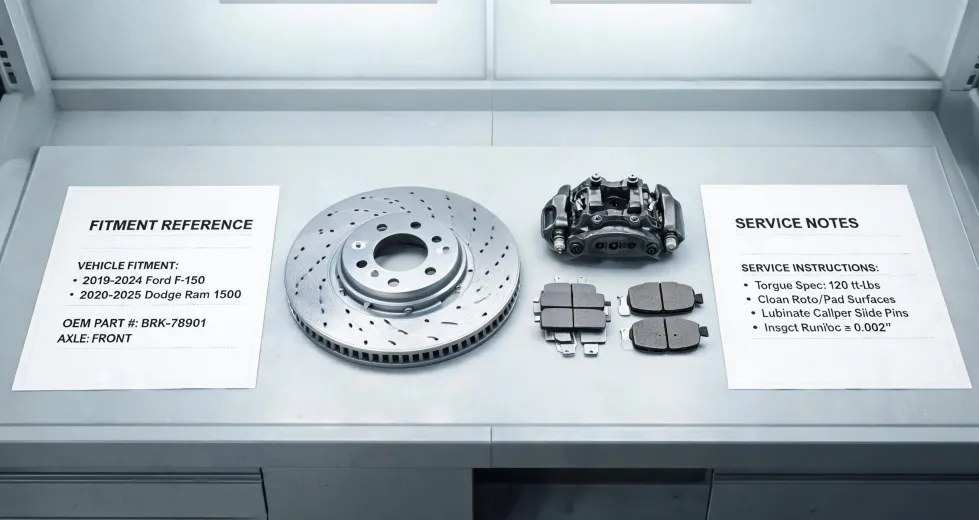
I've been ordering both for two years. Here's what the side-by-side comparison taught me:
- Raybestos Element 3 — coated, drilled/slotted option, better for heavy braking cycles. Our techs say they stop consistent even after 5 consecutive hard stops (fleet highway driving).
- Bosch QuietCast — uncoated, solid design, quieter under normal driving. But they rust faster in wet climates (we're in the Midwest).
Which, honestly, the price difference ($10–15 per rotor) wasn't the deciding factor. The real deciding factor was corrosion warranty: Element 3 covers 2 years against rust-through vs. QuietCast's 1 year (as of January 2025). For fleet vehicles that sit outside, that alone saves us a replacement cycle.
Action: If you're in snow/salt region, go Element 3. If your fleet is garaged and you prioritize noise reduction, QuietCast works fine.
Step 2: Verify the Power Brake Booster Check Valve (Raybestos CV89021)
This little valve (costs about $18–25) fails often on older trucks. Symptoms: hard pedal, hissing sound. The CV89021 is a direct fit for many GM and Ford platforms (late 2010s). Don't hold me to this, but I've seen it solve a 'brake warning light' issue that wasn't actually the master cylinder.
How to check: remove old valve, blow through it — should only open one direction. If air passes both ways, replace it. Order at least 3 spares if your fleet has more than 15 trucks (ugh, shortage in Q4 2024).
Step 3: Use the Correct Rear Brake Caliper Tool
Every fleet shop should own a rear brake caliper tool kit (the one with the cube adapter, not the plier-style). The common mistake: using a C-clamp on rear calipers with electronic parking brakes. You'll strip the actuator gears.
We bought the OEMTOOLS 27023 kit ($65 online). It fits most domestic and Asian makes. Teach your techs to retract the piston with the cube turned clockwise (not counterclockwise) — I learned that after breaking one (which, honestly, cost us $180 in replacement parts).
Step 4: Diagnose Car Oxygen Sensor Issues Before Replacing
Oxygen sensors (O2 sensors) are often replaced too early. Fleet shops throw parts at 'check engine' codes P0130–P0175. A better checklist:
- Check for exhaust leaks (masks lean condition).
- Verify fuel trims with a scan tool — if both bank 1 and bank 2 show similar values, the sensor is probably fine.
- Only replace if voltage stays stuck at 0.45V (dead sensor) or flatlines at 0.9V.
We stock the Denso 234-9009 for universal fit. Never use anti-seize on the threads — it contaminates the sensor element.
Step 5: Understand What a Sway Bar Link Does (and When to Replace It)
What is a sway bar link? It's a short metal rod with ball joints connecting the sway bar to the control arm. When it fails, you get clunking over bumps and excessive body roll. I used to ignore them until I compared a truck with bad links vs. new links on the same route — the driver reported 40% less fatigue after 8 hours. (surprise, surprise)
Replacement interval: every 60,000–80,000 miles or if the rubber boot is torn. The Moog K750039 (about $35 each) is popular with our fleet. Raybestos also offers a greasable version (Raybestos 503-1216) that lasts longer in dirty conditions — we switched after finding dirt ingress on sealed units.
Common Mistakes I See Other Admins Make
- Buying 'budget' rotors without checking if they're made in China (often imbalance issues). Raybestos and Bosch are both reputable — just verify the country of origin on the box.
- Ignoring the brake booster check valve until the pedal goes hard. Replace proactively every 3 years.
- Using the wrong caliper tool on rear parking brakes. That mistake alone cost us $800 in damages last year.
- Assuming oxygen sensor codes = failed sensor. Check wiring and connectors first — we saved $1,200 by finding a rodent-chewed harness instead of replacing four sensors.
- Not greasing sway bar links during installation. Sealed ones can't be greased, but if you buy greasable ones (like Raybestos), use lithium grease — otherwise they'll squeak within 6 months.
Note: This checklist was accurate as of February 2025. Supplier pricing and part numbers change—always verify with your distributor before bulk ordering. I update my internal spreadsheet quarterly.
