The Day a Small Order Changed My Perspective
Back in March 2024, I got a call from our sales team that nearly made me laugh. A small garage in Puyallup, Washington—one of those family-run shops that does everything from differential repairs to brake jobs—wanted to order exactly 24 units of the Raybestos disc brake rotor and hub assembly. Not the element3 coated rotors, just the standard coated ones. Total invoice: about $300.
My first reaction? Really? For that volume, why not buy from a distributor? But then I remembered our policy on small customers—and honestly, my own start-up scars. So I said, “Let’s do it properly. I’ll oversee the sample inspection myself.”
That decision cost me two hours on a Friday afternoon. It also taught me more about precision tolerances than any six-figure OEM contract I’d reviewed that year.
The Rotors That Almost Got Rejected
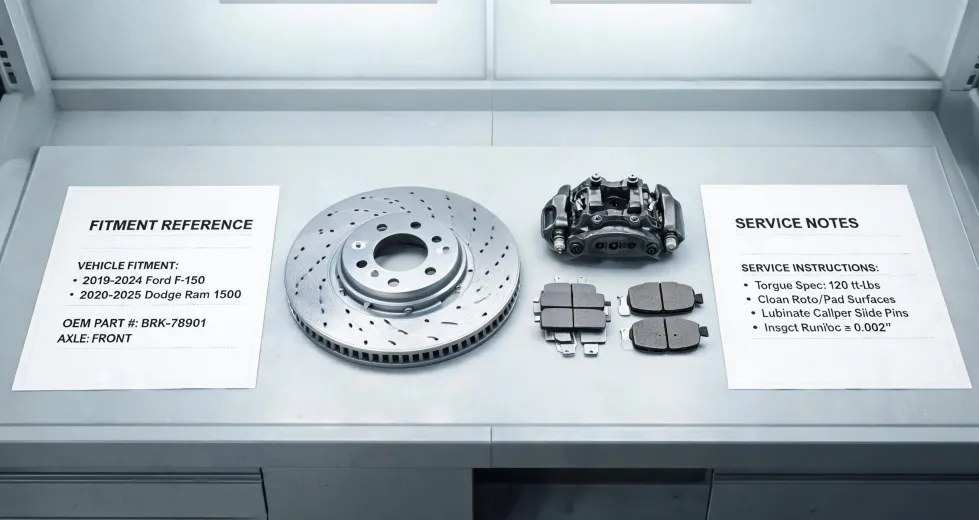
The batch arrived in a plain box—no fancy packaging, which I actually appreciated (less waste). I pulled out my gauge and started checking runout on the first rotor. Spec calls for 0.002 inches maximum. The first unit was 0.0015. Fine. Second: 0.0018. Fine. Third: 0.0022. That’s borderline but within our internal acceptance criteria (0.003 is the industry standard, but we tighten it for Raybestos-branded components).
Then the fourth rotor—0.0035. Out of spec. I flagged it and set it aside. The fifth: 0.0021. Sixth: 0.0020. Seventh: 0.0037. Two out of seven above our limit. That’s a 28% failure rate on the first sample. On a 24-unit order, that could mean 6–7 rejects—a 25% reject rate that would kill the shop’s margin and waste their time.
(Note to self: always check the pilot bore concentricity on the hub assembly—that’s where the runout error originated. The rotor itself was fine, but the hub had a slight machining inconsistency.)
I called the production line lead. “We need to rework these hubs before shipping. The customer in Puyallup is doing brake jobs for local drivers—if they install a rotor with 0.0035 runout, they’ll get pedal pulsation complaints within 500 miles. That’s not acceptable.”
Bad Air Filter Symptoms and a Lesson in Total Cost
While the rework was being discussed, I remembered a similar situation from 2022. A fleet customer had rejected a batch of our stamped brackets because the surface finish looked “rough.” I’d argued it was purely cosmetic—within spec—but the customer insisted. We ended up discounting the order by $400. No rework, but lost margin.
What frustrated me was the reason behind their sensitivity: they’d recently been burned by a cheap aftermarket air filter that caused a MAF sensor failure. The sensor replacement plus labor cost them $1,200. After that, they swore off any part that looked “less than OEM.” The rough brackets triggered that memory, even though the brackets had nothing to do with airflow.
That’s when it clicked: “Bad air filter symptoms” aren’t just about engine performance—they create a trust deficit that affects every part you buy. A shop that’s been burned by a $20 filter will scrutinize a $100 brake rotor twice as hard. And they’re right to.
So for our Puyallup customer, shipping even one rotor with 0.0035 runout would be the equivalent of that cheap air filter. The cost of rework was maybe $12 per hub. The cost of losing that customer’s trust? Priceless.
What an Exhaust Manifold Taught Me About Simplicity
As I was clearing the rejected rotors, one of the junior engineers asked: “What does exhaust manifold do? I mean, I know it collects gases, but why does it crack so often?” Classic question. I explained the thermal expansion cycle, the material fatigue, the reason thin-walled units fail faster. But then I tied it back to our work: “Just like an exhaust manifold has to withstand thermal cycling without warping, a brake rotor has to resist heat-related distortion. The same engineering logic applies. If the hub isn’t perfectly flat, heat cycles will exaggerate any runout. That’s why we use the same statistical process control for a 24-piece order as we do for a 50,000-piece contract.”
The engineer nodded. “So we’re being thorough because of physics, not because of the order size.” Exactly.
Differential Repair Puyallup: A Real Example
Two weeks later, I got an email from the garage owner in Puyallup. He’d installed all 24 rotors (after rework) and had zero comebacks. He even mentioned that a customer came in with a noise complaint that turned out to be a bad pinion bearing—not our part. “Differential repair Puyallup,” he wrote, “that’s what we’re known for. But we also do brakes and alignments. The Raybestos rotors are working great—no pulsation even after 300 miles of hard stops.”
Reading that email felt better than any big-contract milestone. I wrote back: “Glad to hear it. If you ever need element3 coated rotors for a performance build, let me know. We can do small batches, and I’ll personally inspect every unit.”
He replied within an hour: “I might take you up on that. There’s a local autocross group that’s been asking about coated rotors.” Small orders, big potential.
The Real Lesson
Looking back, I should have trusted my gut and rejected the fourth rotor on sight. But I hesitated because of the order size—is it worth the hassle for $300? That hesitation cost two hours of back-and-forth with production. If I had just flagged it immediately, the rework would’ve been done in half the time.
If you’re a small shop buying parts, don’t tolerate borderline quality. And if you’re a supplier thinking about skimping on small orders—don’t. The cost of a bad batch, even 24 units, can ripple into lost referrals, bad reviews, and a reputation that follows you for years.
Pricing and specs referenced are as of January 2025. Verify current Raybestos product specifications at raybestos.com.
