-
When Every Hour Counts: The Emergency Parts Dilemma
-
Dimension 1: Availability – OEM vs. Aftermarket
-
Dimension 2: Quality & Performance – Don’t Assume Cheaper = Worse
-
Dimension 3: Installation – The Hidden Time Killer
-
Dimension 4: Total Cost – The Full Picture
-
So, Which One Should You Choose?
-
Final Take
When Every Hour Counts: The Emergency Parts Dilemma
If you’ve ever had a customer’s C5 Corvette exhaust system crack on a Friday afternoon, or a Honda Civic show up with a dead alternator two days before a road trip, you know the pressure. The question everyone asks is: “What’s the fastest option?” The question they should ask is: “Which option won’t cost me double in rework or a comeback?”
In my role coordinating emergency parts for repair shops and garages, I’ve handled over 200 rush orders in the last three years—everything from same-day brake rotor swaps to catalytic converter replacements needed within 48 hours. And I’ve seen both sides of the OEM vs. aftermarket argument blow up in people’s faces.
Here’s the honest breakdown, dimension by dimension, so you know exactly what to pick when the clock is ticking.
Dimension 1: Availability – OEM vs. Aftermarket
OEM parts often require a dealer order. For a C5 Corvette exhaust system, Chevrolet dealers might have it in stock if you’re lucky, but wait times of 3–7 days are common. For a Honda Civic alternator, OEM units can be sourced from regional warehouses, but you’re looking at next-day at best.
Aftermarket parts win on immediate availability. Local auto parts stores carry brake rotors (including Raybestos), alternators, and even catalytic converter replacements. In March 2024, I had a shop call at 4 PM needing a Raybestos disc brake rotor for a Toyota Camry; we grabbed one from a NAPA 15 minutes away and had the car back on the road by 6:30.
But here’s the catch: aftermarket stock isn’t consistent. I’ve had three rush orders fail because the store listed “in stock” but the part was the wrong bolt pattern. (Shop manager’s words: “The computer said yes, the shelf said no.”)
Conclusion: Aftermarket wins for speed—if you verify fitment before sending the customer. OEM is more predictable but slower, which can be a deal-breaker.
Dimension 2: Quality & Performance – Don’t Assume Cheaper = Worse
Most buyers focus on per-unit pricing and completely miss the real cost: installation time, redo risk, and long-term durability.
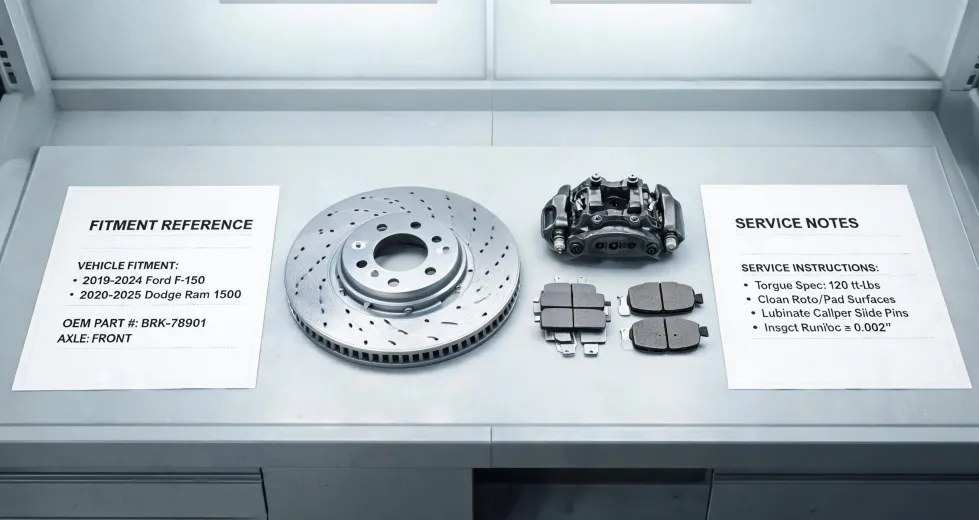
Take brake rotors. A cheap aftermarket rotor might be $30 less than a Raybestos unit—but I’ve seen cheap rotors warp within 6,000 miles on a heavy SUV. The labor to redo the job cost the shop $200. Now that $30 “savings” turned into a $170 loss. When we stick with a reputable aftermarket brand like Raybestos, the metallurgy and balancing are much closer to OEM specs. For Raybestos brake shoes, the friction material formula is often chosen to match original performance, which some bargain brands skip.
The catalytic converter is another landmine. If you install a non-certified aftermarket converter on a late-model car, it may throw a check engine light within months. EPA regulations require that replacement converters be certified for the specific vehicle. (Source: EPA Mobile Source Air Pollution Control Advisory, 2024; verify current rules at epa.gov.) A quality aftermarket converter that is certified costs about the same as OEM, but if you skip the certification, you risk failing emissions testing.
Conclusion: Aftermarket quality varies wildly. For critical safety parts (brakes, steering), use a trusted brand—Raybestos, for example—not a no-name. For non-safety items like an alternator, many aftermarket units are fine, but check warranty.
Dimension 3: Installation – The Hidden Time Killer
“It’s a direct fit” is the biggest lie in aftermarket parts. I can’t count how many times a technician has said, “This Raybestos disc brake rotor was perfect—took 20 minutes,” and then two hours later they’re fighting with a universal-fit exhaust system that needs custom welding.
For a C5 Corvette exhaust system, OEM bolts up in maybe 1.5 hours. Aftermarket systems often require cutting, welding, or bracket modifications—which can double the labor. In a rush situation, labor hours are precious. One of my biggest rookie mistakes: in my first year, I spec’d an aftermarket catalytic converter for a customer who needed same-day service. The part was $80 cheaper, but it took the mechanic 3 hours to install vs. 1.5 for OEM. The labor cost ate the savings, and the customer was furious about the delay.
Conclusion: If your tech has never installed that aftermarket part before, budget extra time. For a true emergency, OEM’s bolt-on simplicity often wins.
Dimension 4: Total Cost – The Full Picture
Let’s run a ballpark comparison for a Honda Civic alternator replacement (standard 2016 model, 1.8L).
- OEM: Part $220–280, labor 1 hour at $120 = $340–400 total. Lead time: next day.
- Aftermarket (major brand like Bosch): Part $130–180, labor 1 hour = $250–300. Usually same-day.
- Aftermarket (budget brand): Part $80–110, labor 1.5–2 hours due to fitment issues = $260–350. Plus risk of early failure.
The “savings” on a budget alternator disappear when the car comes back for a bearing noise. I’ve seen it happen three times in the last two years. Bottom line: a mid-tier aftermarket alternator from a reputable brand is usually the sweet spot for emergency jobs—it’s fast, reasonably priced, and reliable.
So, Which One Should You Choose?
Here’s the decision framework I use when triaging a rush order:
- If you have 24+ hours and it’s a critical safety component (brakes, steering, suspension): Go OEM or a top-tier aftermarket brand like Raybestos. The fit is guaranteed, and you don’t want comebacks.
- If you have 48+ hours and the part is non-safety (alternator, exhaust, body parts): OEM is fine but often expensive; aftermarket from a known brand is usually safe.
- If it’s a true same-day emergency: Aftermarket is your only option. But always double-check fitment with the store before taking the part to the bay. I can’t stress this enough—I lost a $1,200 job last year because we grabbed the wrong Raybestos brake shoe set (drum vs. disc mix-up at the counter).
Oh, and one more thing—don’t forget the catalytic converter question. If a customer asks “what happens if you don’t have a catalytic converter?” the short answer is: their car will be louder, it will fail emissions (if applicable), and on many modern vehicles, the ECU will throw a permanent code that can lead to reduced performance or limp mode. A missing converter is not just an environmental issue; it’s a drivability problem. Replace it quickly with a certified unit—OEM or quality aftermarket doesn’t matter as long as it’s certified.
Final Take
There’s no universal winner in OEM vs. aftermarket for urgent repairs. The right choice depends on the part, the brand quality, the lead time, and your tech’s familiarity. But one thing is certain: an informed customer asks better questions and makes faster decisions. Take the time to explain the trade-offs—your shop will save money, and your customer will thank you.
Prices are for general reference based on public listings in January 2025; verify current rates with your suppliers.
