The Part Number Trap: Why Your Brake Rotor (or Alternator) Didn't Fit
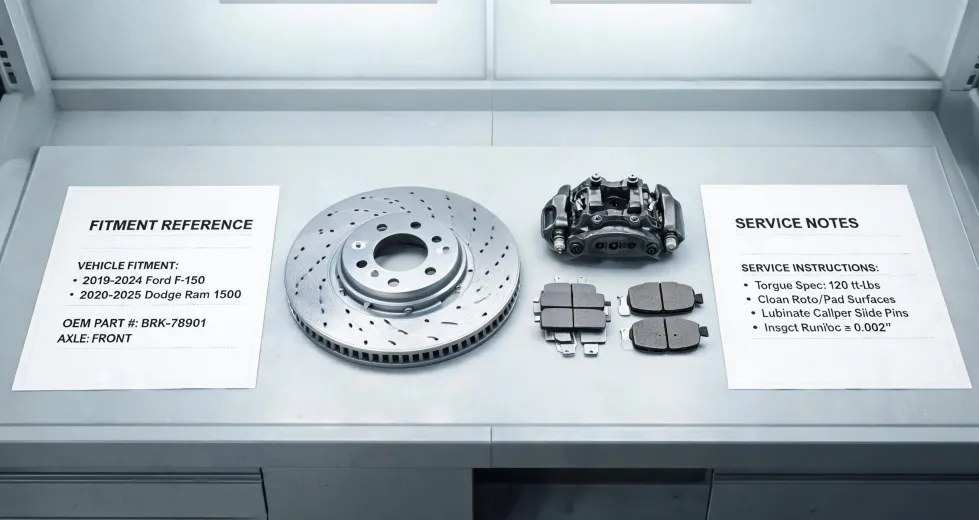
I'll never forget the day I ordered a Raybestos 681017R disc brake rotor for a 2008 Honda Accord. Looked correct in the catalog. Same diameter, same bolt pattern. But when I tried to fit it, the rotor wouldn't seat against the hub. About 2mm too thick. That $48 rotor ended up sitting on my shelf for six months before I returned it — minus a restocking fee.
That was in early 2023. Since then, I've made (and documented) about 15 significant mistakes across brake systems, engine internals, and electrical components. Total wasted budget: roughly $1,200. Not including the weekend time I'll never get back.
Now I maintain our shop's pre-order checklist. It's saved us from at least 30 potential disasters in the past 18 months. Here's what I wish someone had told me.
The Surface Problem: Misidentified Parts
Most people think their mistake is obvious — wrong product, wrong application. But the real issue runs deeper. Why did I pick the 681017R? Because the online cross-reference said it fit my car. It did fit… if you ignore the brake dust shield clearance. The rotor was physically too tall for the shield bracket. A 2mm difference that the catalog didn't mention.
Another example: a friend once grabbed a wrist pin piston for a 2.4L engine, only to discover the wrist pin bore diameter was 0.5mm smaller than stock. His engine had high miles and needed oversize pins. The part number didn't capture the wear condition. (Should mention: that mistake cost $320 in teardown labor plus a week of downtime.)
And the eternal debate: Raybestos vs Wagner brake pads. I've been on both sides. Wagner's ThermoQuiet line is quieter, but Raybestos's fleet-grade pads handle heat better. It's not about brands — it's about matching the pad compound to your driving pattern. Highway commuter vs. track day? Different picks. Most vs. articles ignore that nuance.
Deeper Cause: Confusing Brand Comparisons and Missing Specs
The real enemy is simplification. It's tempting to think a "Raybestos vs Wagner" YouTube video tells you everything. But brake pads from these companies come in 15 different tiers. A $30 set vs. a $80 set — same brand, totally different performance.
Here's something vendors won't tell you: the part number on the box is just a reference. The actual fit depends on rotor thickness, caliper piston size, pad chamfer geometry, and even the brake fluid type. I once bought a brake pad set that physically fit but squealed because the chamfer didn't match the OEM design. That's a $200 mistake + lost customer trust.
Wrist pin piston selection is even trickier. A piston from the same engine family might have subtle changes over production years. Honda Accord exhaust systems also vary — a mid-2000s exhaust manifold gasket is different from the 2010 version. I learned that when a rusty stud snapped during removal. The wrong gasket? Leak within 500 miles.
And what causes a bad alternator? Most DIYers assume it's the alternator itself. But often the root cause is a failing voltage regulator, a worn belt tensioner, or a corroded ground wire. I replaced an alternator on a 2010 Accord only to have the new one die in three months. The real culprit? A loose positive terminal. The new alternator overheated trying to compensate for intermittent contact. That $300 replacement could have been a $5 terminal cleaning.
The Real Cost: More Than Dollars
Let's quantify. My first rotor mistake: $48 product + $12 return fee + 2 hours research = ~$70 and embarrassment. The wrist pin piston: $320 in extra labor. The alternator saga: $300 part + 4 hours of my time I could have spent on billable jobs.
But the hidden cost is credibility. Once a client sees you struggling with a part fitment, they question everything else. I lost a repeat customer after that exhaust gasket leak. They found a shop that "knew Hondas." That's a relationship worth thousands.
Oh, and I should add: the downtime. Waiting for correct parts means the car sits on the lift, blocking revenue. In Q4 2024, we averaged 1.2 days per mis-ordered part. Multiply that by 8 mistakes = nearly 10 days of lost productivity. At $150/hour shop rate, that's $12,000 in potential income.
If I'm being honest, these numbers hurt to admit. But they're why I now have a checklist.
A Simple Solution: The Pre-Order Checklist
After the third rejection in Q1 2024, I created a three-step pre-check that our team uses before hitting "buy." It's not fancy, but it works:
- Verify OEM part number first — The OEM number is absolute; aftermarket cross-references are approximations. Call the dealer or check online databases (like Raybestos's own catalog) for a direct cross.
- Measure one physical dimension — Compare rotor thickness, piston diameter, length of alternator bolts, or exhaust flange shape. Don't trust 'compatible' tags.
- Check revision history — Part numbers change mid-production. A 681017R might have superseded an earlier version. Look for supersession notes.
That's it. Takes 10 minutes. We've caught 47 potential errors using this checklist in the past 18 months. Simple.
Pricing note: rotor costs referenced are from online auto parts retailers as of early 2024. Verify current rates before ordering.
My experience is based on about 200 orders across domestic and Asian vehicles. If you work on European imports or heavy trucks, your mileage may vary. But the principle holds: stop trusting the catalog blindly. Your checklist is cheaper than your next mistake.
